Different Ways We Communicate in Therapy: Finding What Fits You

Understanding how different formats shape the therapeutic experience

Therapy isn’t one size fits all. Whether in person, by video, over the phone, or through writing, each format offers something distinct

Why the Format Matters

Communication isn’t only about words — it’s also about tone, pauses, body language, and timing. Different therapy formats highlight different parts of that connection.

In-person sessions give you the full spectrum: sight, sound, and presence. Online sessions trade physical closeness for accessibility and comfort. Asynchronous writing (such as email) offers reflection and distance, while live text gives immediacy without the pressure of being seen.

There isn’t a “best” way, only what’s most supportive for you at this point in your journey. The goal isn’t to rank therapy formats, but to find what helps you feel safe enough to be real.


shallow focus photo of woman in beige open cardigan

In-Person

In-person sessions remain the traditional model for a reason. Sharing physical space can help some people feel grounded and contained. You can see and be seen — micro-expressions, posture, and the subtle rhythms of breathing all play a part.

The room itself becomes part of the therapeutic frame, offering stability week by week. But being physically present can also feel intense or exposing. Travelling to a session, sitting across from someone, or maintaining eye contact can heighten anxiety, especially early on.

For some, the effort of getting there outweighs the benefit. In-person work thrives on embodied presence, but it’s not the only way to build connection..

Video Therapy

Video sessions bring the therapist to you — literally into your own space. You keep visual cues and tone, while also having control over your environment: your lighting, your drink, your blanket.

For many, that combination makes therapy more accessible and less intimidating. The downside is that technology introduces its own barriers — screen fatigue, lag, or self-consciousness about being on camera.
Distractions at home can interrupt focus, and containment requires more active effort from both sides.

A good online therapist will name these differences and help you create a virtual space that feels private, stable, and grounded.

Young cheerful female smiling and talking via laptop while sitting at wooden table in cozy kitchen
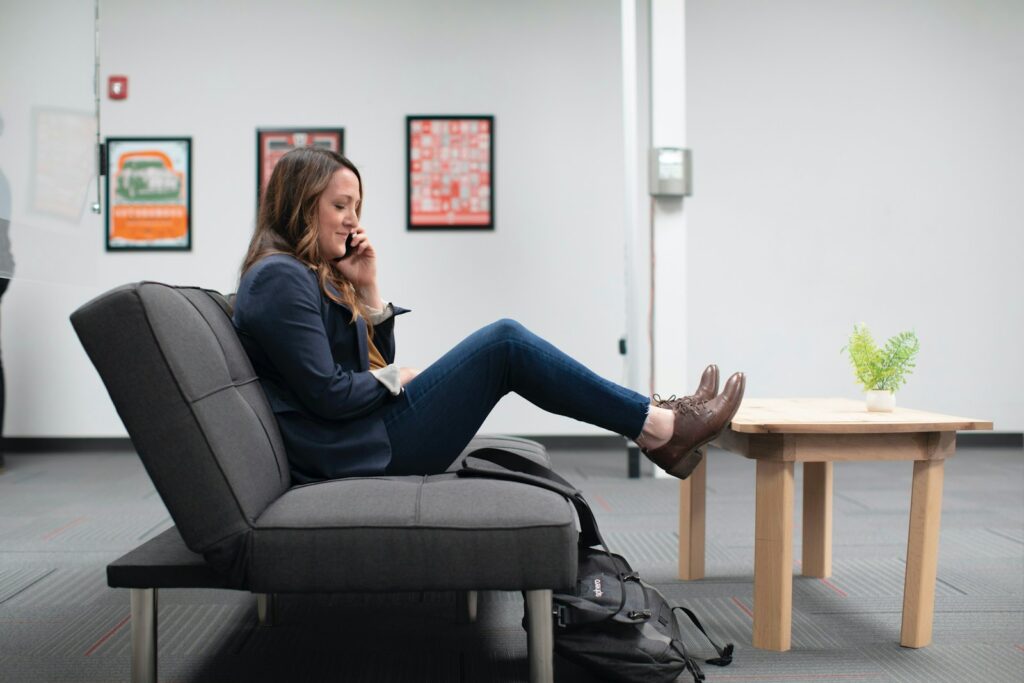
woman in blue denim jeans sitting on black office rolling chair

Phone Therapy

Phone work strips the process down to voice alone. Without visual cues, both client and therapist often listen more deeply. The voice carries tone, breath, and the texture of emotion.

Some find this freeing; others feel lost without facial expressions or eye contact. It can be particularly grounding for people who find visual interaction overstimulating, or who want the freedom to move during sessions.

Phone sessions rely on trust in the unseen — a connection built through tone and pacing rather than sight.

Live Text or Chat Therapy

Typing in real time can be surprisingly powerful. Writing slows thought and allows you to choose your words carefully. For those who struggle to speak under pressure or process internally, live chat offers a gentler entry point.

The written record also helps reflection — you can scroll back and notice patterns or progress.

However, without tone or body language, meaning can sometimes be misread, so therapists working this way check in and clarify more often. Live chat holds immediacy without visibility: it’s intimate and distanced all at once.

a close up of a person holding a cell phone
person using silver laptop computer on desk

Asynchronous Therapy (Email or Message-Based)

Asynchronous therapy is the most flexible format — and the most misunderstood. You write when you’re ready; your therapist responds later within an agreed timeframe.

It gives space to reflect and find words that might feel too heavy to say aloud. It’s particularly useful for those who process slowly, need structure, or live with unpredictable schedules.

But it also has clear limits: no real-time containment, delayed feedback, and a greater risk of what psychologists call the online disinhibition effect — the tendency to overshare quickly when not face-to-face.

That’s why clear boundaries, timeframes, and disclaimers matter. Asynchronous work isn’t suitable for crisis situations; it relies on self-awareness and strong collaboration.

Matching the Medium to the Moment

The best format isn’t permanent — it’s situational. Some clients move between modes over time: beginning with written work to find safety, then shifting to video or in-person as confidence grows.

Others stay with one form because it fits perfectly. Therapy works best when the method supports, rather than distracts from, the process.

The Role of Containment

Every mode of communication has its own version of containment — the structure that keeps the work safe.

  • In-person: the room, the chair, the therapist’s presence.
  • Online: the digital boundaries, the privacy of the platform, and the clarity of agreements.
  • Asynchronous: the contract, timeframes, and the understanding that messages aren’t real-time support.

Containment isn’t about restriction; it’s about safety — knowing where therapy starts and ends so both therapist and client can be fully present within it.

Therapy as Collaboration

Whatever the format, therapy is always a shared space. The therapist brings training and ethics; the client brings lived experience and courage.

Between the two, communication becomes more than words — it becomes understanding.

A good therapist will help you explore which medium serves that understanding best, and will review it together as your needs evolve.

Therapy isn’t defined by Medium – but by the Connection

Therapy isn’t defined by the screen, the chair, or the signal — it’s defined by connection. Each format offers a different doorway into that connection, and sometimes the one you least expect turns out to be the one that fits best.

The key is choice, clarity, and care — finding a way to communicate that supports who you are, and where you are, right now.

At Safe Spaces Therapy Online, therapy is flexible by design. Whether you prefer in-person depth, online balance, or reflective writing, we’ll find a way to connect that feels safe and sustainable for you.

Scroll to Top