
How Society Learns to See What Was Always There
How society learns—and forgets—to see what was always there
Every few years, the world “discovers” something that has quietly existed all along. It happened with queerness, with mental health, with trauma, and now with neurodiversity.
Each time, people act as if a new species has appeared. In truth, the language finally caught up with the lives that were already being lived.
At a glance
- Social acceptance moves in loops, not lines — discovery, discomfort, backlash, integration, and renewal.
- Every new visibility (queer, neurodivergent, trauma-informed) follows a rhythm: excitement, resistance, then quiet normalisation.
- Regression isn’t failure; it’s society recalibrating its tolerance and learning where its limits still lie.
- True acceptance begins when difference stops being a headline and simply becomes part of everyday life.
I’ve watched this rhythm play out more than once.
When I came to London, the age of consent for gay men had just dropped from twenty-one to eighteen. Section 28 still hung over schools. Civil partnerships were whispered about like scandal, then celebrated like revolution, and later replaced by marriage equality.
Every step forward came with celebration, confusion, and backlash in equal measure. That same rhythm is unfolding again—this time around neurodiversity.
The cycle of visibility
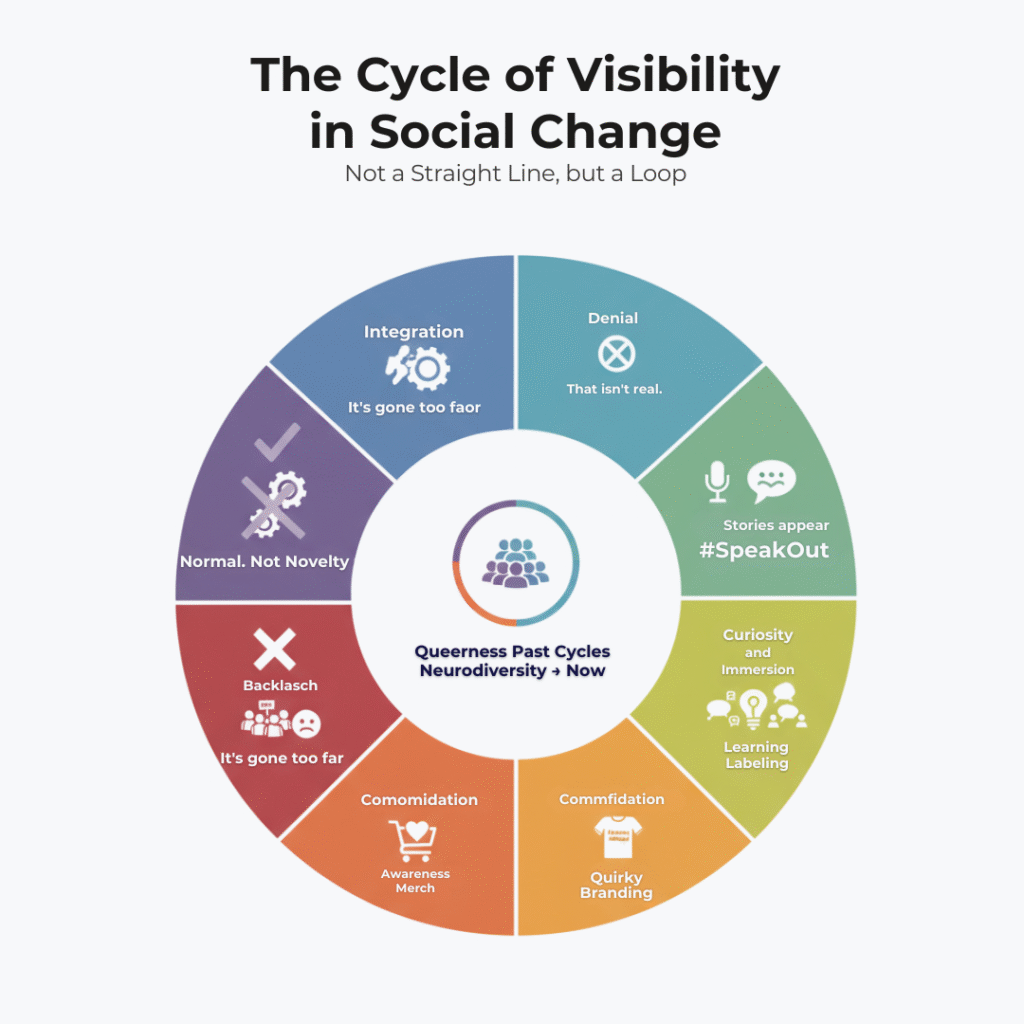
Social change rarely moves in straight lines. It loops.
First comes denial: “That isn’t real.” Then visibility: people speak, stories appear, hashtags form.
After that, curiosity and immersion—the noisy stage where everyone is learning, labelling, experimenting.
Next arrives commodification: awareness campaigns, merchandise, and “quirky” branding. Then inevitably, backlash: “It’s gone too far.”
Finally, if we’re lucky, integration—when the new language stops being novelty and starts being normal.
Queerness has cycled through those phases more than once. Neurodiversity is moving through them right now.
From silence to vocabulary
When people first hear a new term—autism, ADHD, sensory sensitivity—the impulse is to treat it like a fashion statement. But the sudden surge of language isn’t the problem; it’s the symptom of years without it.
Language is how culture heals amnesia. Before words appear, people sit in isolation, convinced their difference is failure. Once words arrive, they pour out too fast, too loud, and occasionally off-key. That’s how vocabulary grows muscles.
I recently read a comment that “neurodivergence is becoming a trend” captures that anxiety—but misses the other half of the story. Trendiness is what visibility looks like in its adolescence. It’s messy, but it means the silence is breaking.
Lessons from coming out
Those of us who lived through the earlier waves recognise this pattern instantly. Coming out wasn’t one clean act; it was a series of recalibrations.
There was the euphoria of naming yourself, the fatigue of being a walking education system, the sting of backlash, and finally the quiet normality of existing without explanation.
That same logic applies to every new domain of identity.
You move from secrecy to language, from language to community, from community to complexity. The real maturity arrives when difference stops needing to justify itself. But progress has a heartbeat, not a straight line.
Just as we gained marriage equality, we also watched the rhetoric regress—old prejudices dressed in new hashtags. Visibility makes some people generous and others frightened. And frightened people shout.
The current verse: neurodiversity
Right now, society is somewhere between curiosity and backlash. Diagnosis pathways are finally opening, yet the conversation online swings between celebration and cynicism. Neurodivergent traits are called superpowers one minute and pathologies the next. It’s confusing because we’re collectively learning the rhythm.
Those who lived through earlier liberation movements often sit calmer in this chaos. We know the noise is temporary. We’ve seen how a culture that panics about “too much identity” eventually settles into understanding that difference isn’t contagious—it’s ordinary.
Progress doesn’t move in straight lines; it loops. Every backlash is just society catching its breath before the next step forward.
In our personal journey, we cycle back to issues and explore them more fully when we revisit them again with different insights, and society does the same.
Regression isn’t failure
Each backlash feels like betrayal, but it’s actually part of the growth curve. After visibility, societies test the limits of their tolerance. They retreat to nostalgia, rewrite history, and pretend inclusion went too far. That regression hurts, but it’s diagnostic—it shows where the work remains.
The same people who once said “keep it behind closed doors” now say “stop shoving it down our throats.” That’s not moral clarity; it’s stage fright. They’re reacting to visibility, not existence.
Integration—the quiet stage
Integration isn’t a parade; it’s the day nobody needs to debate your right to exist. For queerness, that meant love stories on TV that weren’t “issue episodes.”
For neurodiversity, it will mean workplaces designed for different sensory needs, schools that measure engagement rather than eye contact, and therapy that adjusts to the client’s tempo instead of the other way round.
That stage will come, because it always does. It takes time for language to settle and for novelty to become normal.
Where we are now
We’re mid-cycle: noisy, hopeful, contradictory. People are claiming words that fit and discarding those that don’t. Systems are catching up, slowly. And yes, some will complain that it’s “gone too far.” They said that about every movement that ever mattered.
I’ve learned not to panic at that noise. The backlash is proof that the conversation is happening in the open, not the dark. That’s progress—untidy, unfiltered, but progress all the same.
Tolerance isn’t the final stage of acceptance. It’s just the part where we pause, take stock, and learn to see difference without flinching.
Acceptance & Tolerance aren’t fixed points – they’re an equilibrium/balance – and so are constantly needing micro adjustments to respond to society.
Tolerance of Difference
Every culture has to learn its own tolerance of difference. It does so rhythmically—surging forward, stepping back, pausing, and then moving again. I’ve lived through enough of those surges to trust the pattern.
What’s happening with neurodiversity isn’t new.
It’s the next verse in the same song of human recognition: something long denied becoming visible, spoken, challenged, and finally integrated.
We’ve danced this rhythm before. And every time the music returns, it plays a little clearer.