
Living Beyond Labels and Stigma
Exhaustion from being Labeled before finding your own voice
There’s a strange kind of exhaustion that comes from being labelled before you even find your voice. For some of us, life starts with a series of definitions we never chose — words meant to explain, contain, or make sense of us to others. Gay. HIV positive. Neurodivergent. Disabled. Different. Each one might make sense on its own, but together, they can start to feel like a stack of boxes you’re expected to live inside.
I knew I was gay at around twelve. It wasn’t a revelation, just a quiet recognition — like seeing yourself in a mirror for the first time and thinking, Oh, there you are. At twenty-one, I was diagnosed HIV positive. Another label. Another layer. Then, years later, the learning difficulties that had been written off as trauma responses were recognised for what they were: neurodiversity.
Each discovery came with its own language, its own stigma, and its own period of adjustment. But what nobody tells you is how heavy the combination can feel — how the world often only has space for one kind of difference at a time.
At a glance
- Labels can help us find belonging — but they can also confine us.
- Many people live at the intersection of multiple identities, facing what’s known as the double minority effect (or triple, or quadruple — we can become a niche of a niche of a niche).
- Therapy offers space to move beyond definitions, making room for complexity without needing to simplify who you are.
- Being understood isn’t about fitting in; it’s about being seen as whole.
- Freedom starts when you stop explaining and start existing as yourself.
The weight of being more than one thing
It’s one thing to carry a single label; it’s another to live at the crossroads of several. Society doesn’t always know what to do with intersection — the overlap where identities blur and don’t fit the neat categories people prefer.
There’s a loneliness that comes with being too much of one thing to belong in one space, and not enough of another to belong elsewhere. In the LGBTQ+ community, HIV still carries shadows of judgement. In medical settings, neurodivergence is often misunderstood. And in the wider world, people can reduce you to whatever label makes them most comfortable.
People think labels make things clearer. Sometimes they just make people smaller.
When I introduce myself, I say I’m Charlie – it’s the best label for me. The rest are just facets not the sum of who i am.
Over time, you start to internalise that shrinking — to edit parts of yourself depending on the room you’re in. You learn which version feels safest. And it’s not always the truest one.
The problem with being ‘explained’
Labels are supposed to create understanding. Sometimes they do. A diagnosis can bring relief, language, and validation. Knowing you’re not alone matters. But labels can also become shorthand for assumptions. They can turn into gatekeepers that others use to tell you who you are — or what you’re capable of.
When I was younger, I thought the aim was to manage my labels neatly, to line them up in a way that made sense to others. But life doesn’t work like that. The reality is fluid. Experiences overlap. Trauma and resilience coexist. Pain and purpose intertwine.
The danger comes when people treat labels as limits rather than lenses — as if they define the full story instead of offering context for it.
From survival to synthesis
For a long time, my energy went into survival. Into explaining. Into justifying. Into making others comfortable. It takes years to realise how much of that effort isn’t actually about being seen — it’s about managing other people’s discomfort with your reality.
Therapy helped me unlearn that. Not because therapy gives answers, but because it gives space. The kind of space where you can exist without translation. Where no one is trying to fix the contradictions, just hold them long enough for them to make sense together.
That’s when I began to understand something I later called utilitarian pluralism — the idea that authenticity comes not from picking one version of yourself, but from integrating the parts that make you whole. You stop performing for acceptance and start living from coherence.
It’s not about denying what’s hard. It’s about refusing to let difficulty define the entirety of you.
The hidden labour of stigma
Stigma is quiet work. It’s the daily calculation of how much of yourself to show. It’s the pause before mentioning medication, or the hesitation before saying “I’m autistic” in a room full of professionals. It’s the quick scan for facial expressions — the subtle flicker of pity or fear or judgement — before deciding whether to keep talking.
What people rarely see is the energy it takes to navigate all that. The constant translation. The invisible emotional tax.
And yet, despite all that, many of us learn to move through the world with grace, humour, and depth. Because living with multiple stigmas doesn’t just sharpen your sensitivity — it expands your capacity for empathy. You see things others miss. You recognise the quiet pain in someone else’s eyes because you’ve worn it yourself.
That’s what stigma never accounts for — the wisdom it leaves behind.
The importance of being understood, not defined
Labels can be useful, but they should never be the whole story. I’ve learned that the real power lies in being listened to — not categorised, not corrected, not pitied. Just listened to.
When someone truly listens, the labels fall away. What’s left is experience, emotion, humanity. And that’s where real understanding begins.
Therapy, at its best, mirrors that. It’s not about diagnosis or identity politics — it’s about presence. It’s about being met where you are, not where the world expects you to be. It’s about hearing your story in your own words and believing it.
Safe spaces aren’t a luxury — they’re a necessity
For people living with layered identities, safety isn’t just about physical or emotional protection. It’s about psychological safety — knowing you won’t have to justify your existence in the process of healing.
That’s why safe spaces matter so much to me. They’re not abstract ideals; they’re living commitments. Places where people can bring the fullness of who they are — sexuality, diagnosis, culture, neurotype, whatever they carry — and be met with respect rather than reaction.
Because when you’ve spent a lifetime being explained, contained, or corrected, being heard can feel revolutionary.
Your reality doesn’t need to be made palatable to be valid.
Your experience doesn’t need to be explained or contained — it’s your existence. And I accept your view of your life as you live it.
Therapy can’t erase the impact of stigma, but it can soften its hold. It can help people unlearn the shame that was never theirs to begin with, and rebuild trust in their own voice.
Living beyond the boxes
I don’t reject the labels I’ve carried — they’ve helped me survive, understand, and connect. But they’re not the whole story. Today, they sit alongside everything else I am: a carer, a counsellor, a traveller, a thinker, a human.
The difference now is that I choose which parts to lead with. I don’t owe the world an explanation. And I don’t need to fit its categories to belong within it.
That’s the message I want anyone reading this to take with them — especially those who carry more than one identity, more than one story, more than one reason to feel unseen. You are not the sum of other people’s assumptions. You are not the collection of labels that once defined your survival. You are the person who lived through them and found a way to make them your own.
Because being listened to — truly listened to — is how we begin to live beyond the boxes.
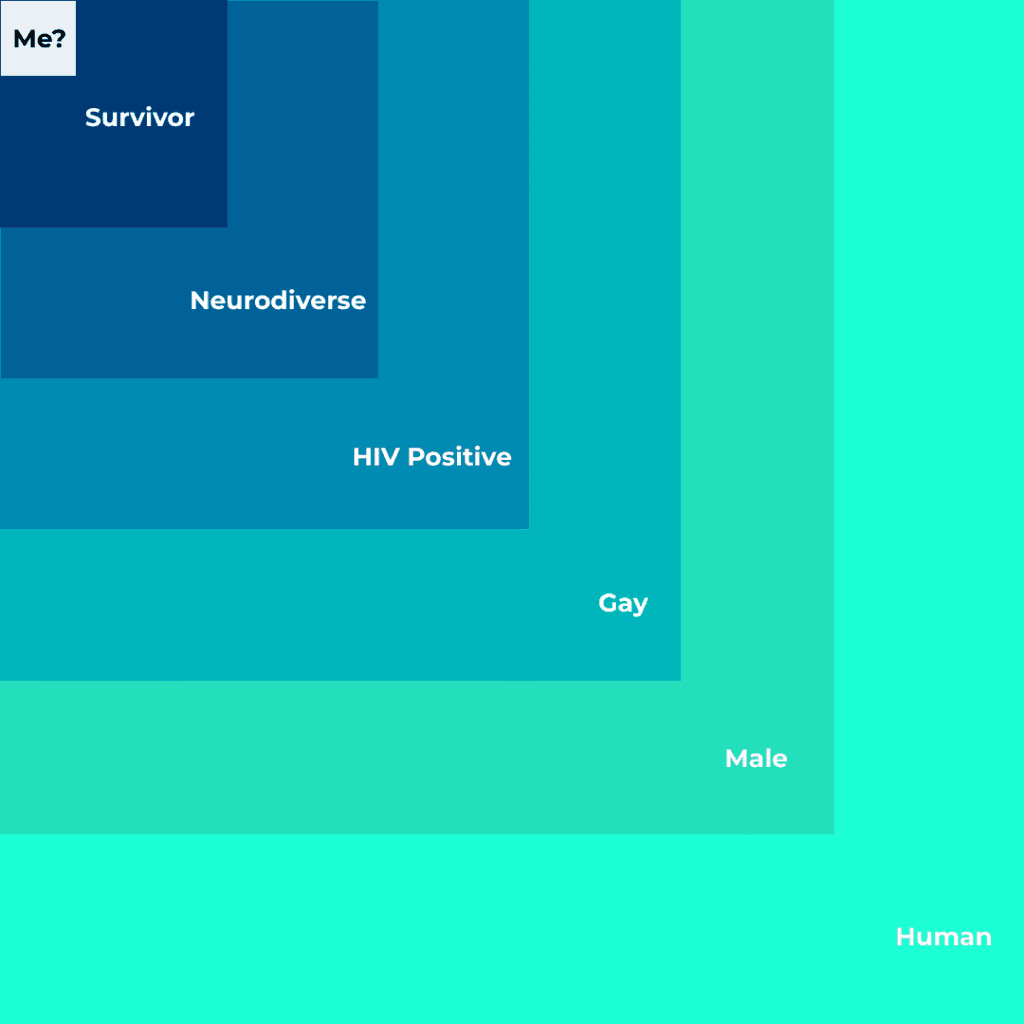
Every label tells a story — and it makes me a minority in a minority.
But that little box isn’t me. I’m the whole container.